
Mastering Energy Dissipation for Critical Water Control
In the world of large-scale water management, where controlling the release of immense hydraulic energy is paramount, the Fixed Cone Discharge Valve stands as an engineering cornerstone. Also widely known as the Howell-Bunger valve or free discharge valve, this specialized equipment is designed for one critical task: to safely, reliably, and efficiently discharge water under high pressure into the atmosphere, converting destructive force into a harmless, dissipated spray. At its core, it is the definitive energy dissipating valve for dams, reservoirs, and hydroelectric systems.
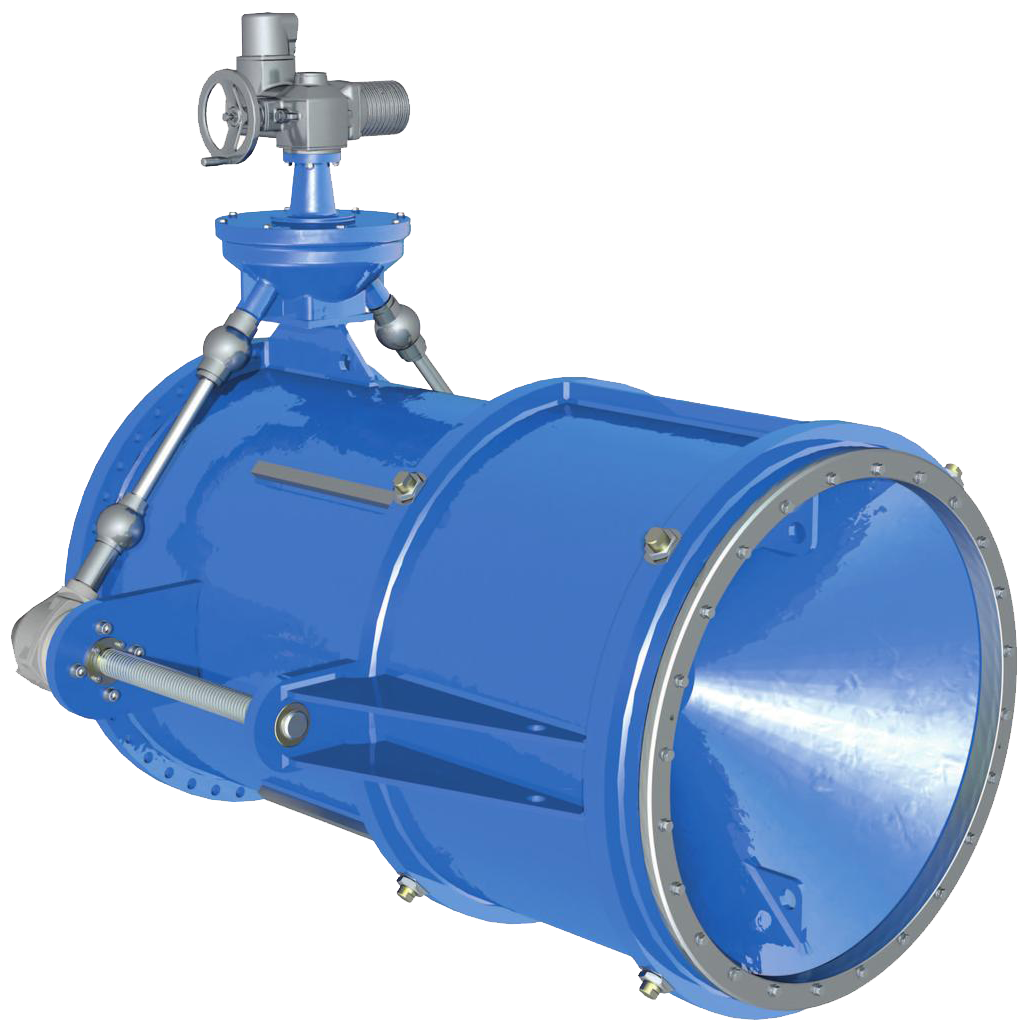
Shield™ Fixed Cone Discharge Valve - 40" 150LB Flanged Type
This valve is the preferred solution for numerous critical applications where reliable energy dissipation is essential:
Dam Outlets & Reservoir Drains: As a bottom outlet valve or reservoir drain valve, it provides controlled dewatering or emergency release.
Energy Dissipation in Hydropower: It serves as an efficient turbine bypass valve during shutdowns or maintenance, handling high-pressure water directly from the penstock.
Flow and Pressure Management: Used for downstream pressure control, flow control in water distribution, and as a pressure relief valve.
Water Aeration: The free-discharge spray effectively aerates water, increasing dissolved oxygen levels, which is vital for downstream ecosystems and water treatment plant discharge.
How It Works: Elegant Design for Maximum Dissipation
Unlike valves that control flow within a closed pipe, the Fixed Cone Valve operates on the principle of free discharge. Its design features a stationary conical deflector (fixed cone) anchored inside a valve body by aerodynamically contoured ribs. Flow is regulated not by the cone, but by a cylindrical sleeve gate that slides axially over the body, uncovering or covering the ports.
When open, water is forced radially outward around the cone, forming a hollow expanding jet. This transformation spreads the water over a rapidly increasing surface area, allowing the energy to be absorbed by the surrounding air—a process known as atmospheric dispersion. This intrinsic design provides hydraulic balance, resulting in remarkably low operating torque and allowing for smooth control over the entire stroke range without vibration.
1
By design, it eliminates the high-velocity impingement on solid surfaces that causes cavitation and erosion in other valve types. Energy conversion happens safely in the air, preventing damage to the immediate environment and downstream structures.
2
With the only moving part in contact with the flow being the sleeve gate, and with external operating mechanisms, maintenance is simplified. Rugged construction from materials like ductile iron or fabricated stainless steel, often with bronze guides and stainless steel seats, ensures a long service life.
3
Its high discharge coefficient (up to 0.87) means a smaller, more economical valve size can often be used for a given flow rate. It adapts to various actuation methods—manual, electric motor actuator, or hydraulic cylinder—and can be fitted with an optional hood (creating a Ring Jet Valve) to confine spray in space-sensitive installations.
4
The unique design provides intrinsic hydraulic balance, resulting in remarkably low operating torque and allowing for smooth control over the entire stroke range without vibration or instability issues common in other high-pressure valves.
5
Converts destructive hydraulic force into a harmless, dissipated spray through atmospheric dispersion, eliminating the need for costly energy dissipation structures downstream of the valve installation.
Whether for flood control, irrigation systems, power projects, or storm water management, selecting the correct Fixed Cone Discharge Valve requires expert sizing based on net head, maximum discharge flow, and site conditions.
Valve size is determined by net head, maximum discharge flow, and site-specific conditions. Our engineers use computational fluid dynamics (CFD) to ensure optimal performance for your application.
Available in ductile iron, fabricated stainless steel, or other corrosion-resistant materials based on water chemistry and environmental conditions.
Choose from manual operation, electric motor actuators, or hydraulic cylinders based on your control requirements and available power sources.
Trusted by Global Projects, Engineered by Leaders
The proven legacy of the Fixed Cone Valve is documented in global projects. Manufacturers like Rodney Hunt (with over half a century of history with the Howell-Bunger valve) and Glenfield (with its Series 857 Free Discharge Valves installed worldwide since the 1950s) set the standard. These valves are engineered to meet international specifications, with designs validated by computational fluid dynamics (CFD) and finite element analysis (FEA), and are rigorously shop tested under hydrostatic pressure.
Download detailed technical drawings, product brochures, and specifications for our valves. These resources provide comprehensive information for engineers, procurement specialists, and maintenance teams.
?Technical Drawings
Complete set of detailed engineering drawings in PDF format for easy integration into your design projects. Includes dimensional drawings, assembly diagrams, and installation guidelines.
Find Technical Drawings of SHIELD Fixed Cone Discharge Valve
Download Product Brochure of SHIELD Fixed Cone Discharge Valve
Download Technical Data Sheets SHIELD Fixed Cone Discharge Valve
See the Installation Manual SHIELD Fixed Cone Discharge Valve
×
Certificate Name:
Description:
Certificate ID:
Issue Date:
Valid Until:
Issuing Authority:
Previous:First
Next :Last

 English
 Chinese
 French
 German
 Russian
 Italy
Italy Spain
Spain Portugal
 Japanese
 Korean
 Arabic
 Traditional